

Estetica Export’s Report from Cosmoprof India 2025
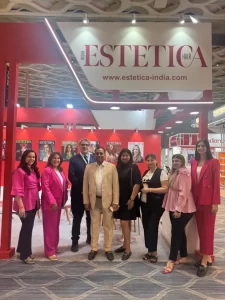
Estetica Export was on the ground in Mumbai—together with our Estetica Hair India edition, led by Rakesh Kumar with the support of Vamika Kaushal, Head of Marketing & Commercial—to capture the real pulse of the market, meet companies, and understand what is truly shaping the future of beauty in one of the world’s fastest-moving economies.
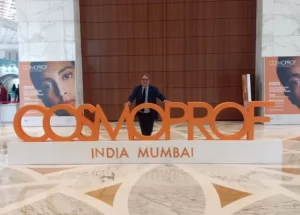
Cosmoprof India 2025 unfolded with the energy that has come to define this show, but also with a distinct atmosphere that only those physically present could grasp. Walking the aisles of the Jio World Convention Centre with Pier Giorgio Scrimaglio, visiting the various country collectives, and speaking directly with manufacturers, brand owners, and machinery suppliers gave us a clear sense of both the opportunities and contradictions of this year’s edition.
Despite the impact of widespread domestic flight cancellations—reducing visitor numbers from several Indian cities—the fair maintained a strong B2B focus. What emerged instead was a very precise pattern: fewer contacts, but significantly more qualified ones. Exhibitors repeatedly shared that conversations were “strategic rather than generic,” pushing companies to sharpen their value proposition with clarity.
India’s Beauty Market: Energetic, Complex, Price-Sensitive—and Rapidly Evolving
One of the strongest impressions from our three days in Mumbai was that India is no longer a market one can approach superficially. Its potential is enormous, but its internal dynamics are unique.
Many exhibitors highlighted how price sensitivity remains a defining characteristic, even more pronounced than in other Asian or Middle Eastern markets. As IDM’s Ivan Riboni noted, companies must “arrive with products whose pricing is sustainable for this market,” because India contains multiple consumption layers—yet the mid-low segment still drives volume.
At the same time, however, the appetite for quality and reliability is rising quickly. Buyers are increasingly seeking well-made, high-performance solutions rather than merely low-cost alternatives. This duality—affordability versus sophistication—is at the heart of India’s current evolution.
A sentiment echoed by FARMEN’s Amin Sidi, who described the show as “very positive,” noting the large number of Indian buyers encountered and stressing the country’s growing interest in natural formulations and in Italian-made products, especially in the premium and professional segments.
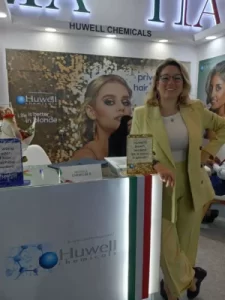
Adding to this perspective, Elisa Pesci of Huwell highlighted the strategic importance of the event for Italian companies:
“Cosmoprof India è un appuntamento fondamentale per le aziende cosmetiche italiane che vedono la potenzialità di questo gigante asiatico e nella sua crescita. Il supporto di ICE rende questa fiera un’opportunità preziosa per raccogliere informazioni ed entrare in contatto con professionisti indiani.”
A More Mature Buyer Base, Seeking Reliability Over Hype
Throughout the fair, one trend became unmistakable: Indian buyers are becoming more selective.
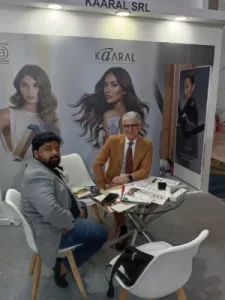
Kaaral expressed this particularly clearly. According to Paolo Pattano, participating with their Indian subsidiary offered a strategic advantage: though the number of meetings was lower than expected, the quality of interactions revealed “a market that is effervescent, growing, and increasingly oriented toward well-made solutions.” Competing with Asian manufacturers, he noted, requires companies to double down on excellence and differentiation.
This evolving buyer profile was visible throughout the halls and across product categories—especially in men’s grooming, an area highlighted by Renée Blanche’s Alessandra Missano, who observed strong interest in men’s haircare, beard products, and even colour solutions. “Even Indian men don’t want to age,” she joked—yet her comment reflects a real shift in consumer behaviour and retail demand.
“New Energy” and a Renewed Global Outlook
For several Italian brands, Cosmoprof India marked a renewed re-engagement with international markets.
Alfaparf’s Filippo Cavalleri shared how energising it was to reconnect after years of reduced travel. Both in Hong Kong earlier this year and now in Mumbai, he felt an audience “truly interested and engaged.” For Alfaparf, India is not merely a distribution market but a professional salon market ready for long-term partnerships.
PH Laboratories’ Claudio Gallina went a step further, describing Cosmoprof India as “an elegant gateway” to a country eager for innovative, accessible beauty solutions—especially those capable of elevating the expectations of its expanding middle class. And indeed, the curiosity and openness of visitors were evident across every hall.
Networking Remains the Weak Link
If exhibitors praised the quality of exchanges, many also pointed out an ongoing weakness: networking tools and matchmaking.
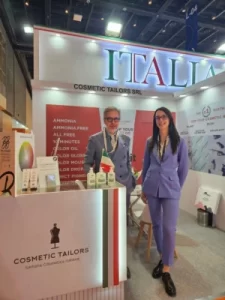
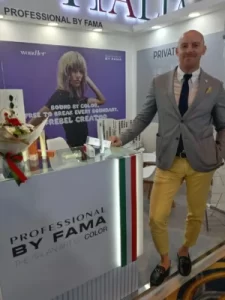
Professional By Fama’s Christian Dalla Libera noted that the digital matchmaking platform “simply didn’t work,” limiting the ability to secure structured appointments. Cosmetic Tailors’ Massimiliano Giobergia echoed this need for more effective formats to bridge supply and demand—especially in a market as vast, fragmented, and multilayered as India.
India Through the Eyes of Pier Giorgio Scrimaglio: “A Market That Must Be Approached Culturally, Not Just Commercially
Pier Giorgio Scrimaglio offered one of the most insightful interpretations of this edition. For him, the fair stood out among all international events attended this year:
Cosmoprof India is one of the shows where I perceived the strongest energy. The market is reactive, alive, and in need of being guided—but only by companies willing to approach it culturally, with respect for a country that is not just a country but practically a continent.
He emphasised a demographic fact that shapes everything: nearly 60% of India’s population is under 35, generating enormous potential for rapid, structural, and lasting shifts in consumption patterns.
Understanding India, he stressed, means understanding the rhythms of its culture and traditions, from the crucial wedding season—an enormous business driver—to major celebrations such as Diwali, which profoundly influence consumer behaviour and purchasing cycles.
“Of all the fairs I attended this year, this is the one from which I returned with the clearest perception that India represents an entire world to be approached with respect, friendship, and long-term relationship building. Here, more than anywhere else, it pays to make friends.”
Key Takeaways from Cosmoprof India 2025
From our direct observation and three days of conversations:
- Quality over quantity: fewer visitors, but significantly more strategic interactions.
- India rewards balance: innovation must pair with accessible pricing.
- Local presence accelerates success: subsidiaries, agents, or frequent visits matter.
- The buyer is maturing: more selective, informed, and long-term oriented.
- Networking infrastructure needs improvement: better matchmaking tools are essential.
- Strong momentum in natural beauty, Made in Italy, and men’s grooming.
Mumbai Confirms Its Strategic Role—And Estetica Export Will Be Back
Cosmoprof India 2025 reaffirmed Mumbai’s importance as a strategic gateway for any beauty brand looking to expand in South Asia. The market is vibrant, competitive, and increasingly sophisticated. Challenges certainly exist—but so do real and immediate opportunities for companies able to understand the nuances of Indian demand.
For Estetica Export, being on the ground with Pier Giorgio Scrimaglio, Rakeysh Kumar, Vamika Kaushal, our Estetica Hair India partners, allowed us to capture not only data and feedback but also the energy, contradictions, and cultural richness of a market that is undeniably on the rise.
We will continue to follow India closely—because its trajectory points unmistakably toward a larger and more influential role in the global beauty economy.